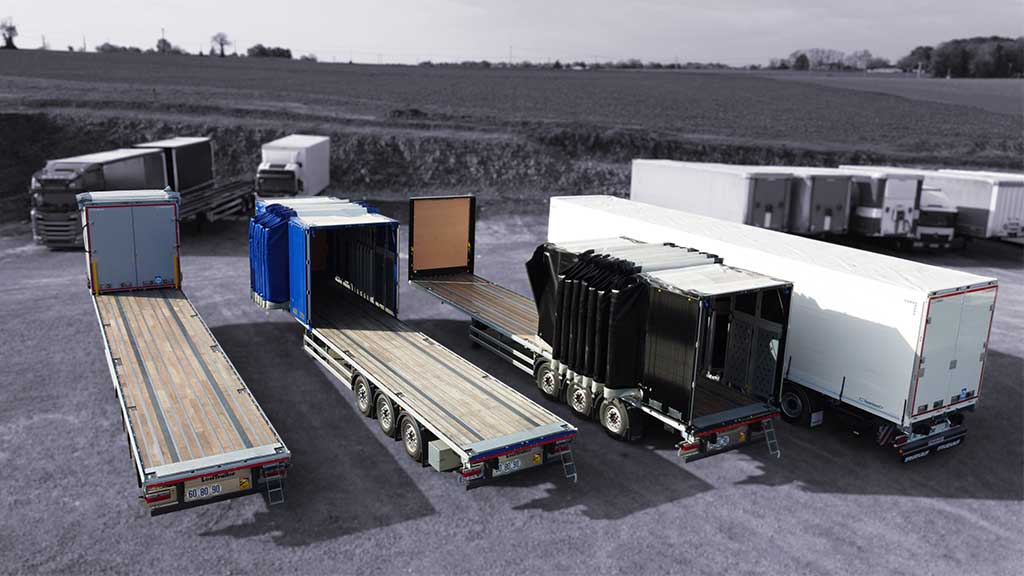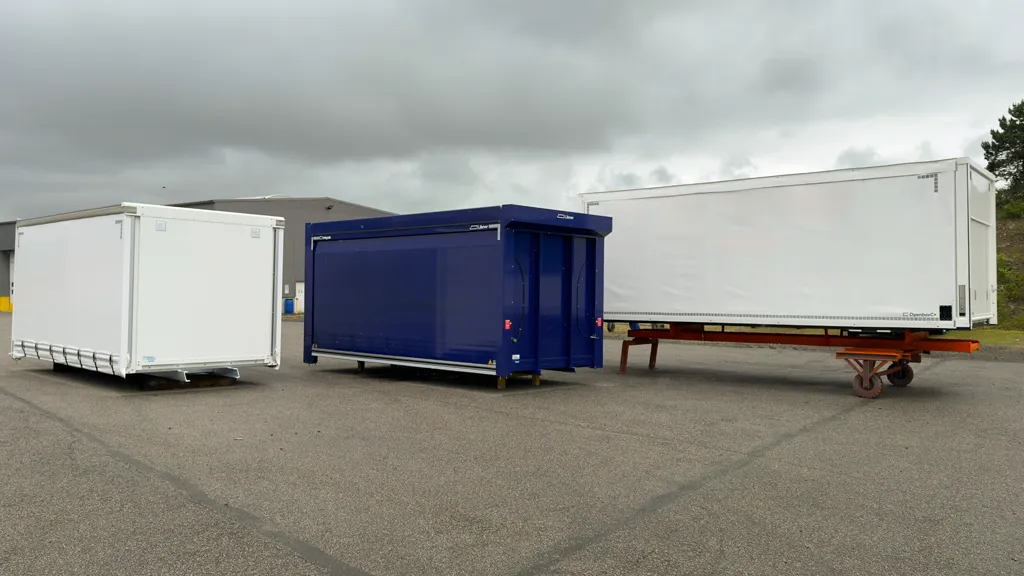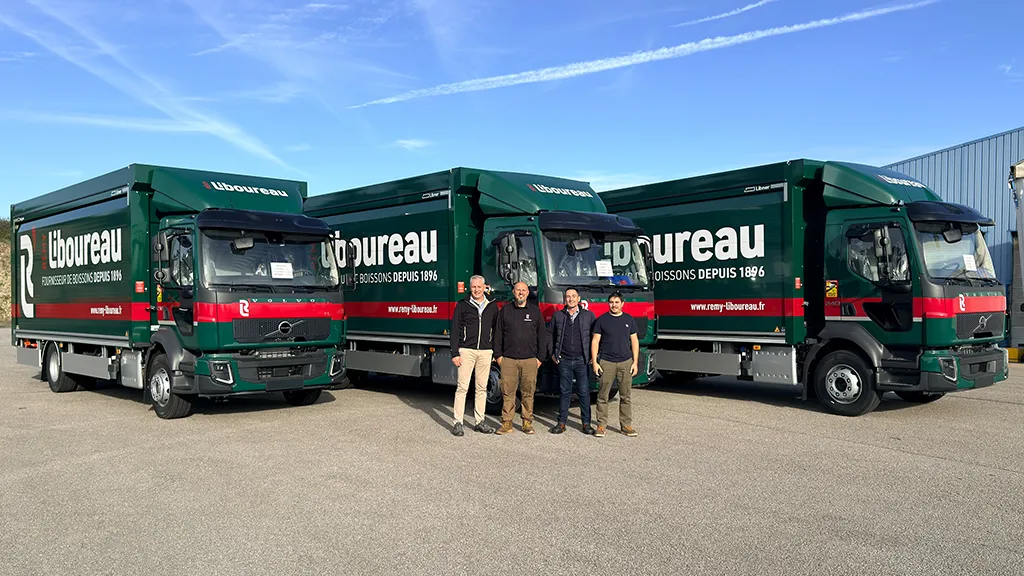


On a truck, load safety does not depend on straps alone. A body certified to EN 12642 Code XL is designed to hold back a large part of the load itself, under braking, when cornering and when reversing. Yet few hauliers know exactly what the standard covers, or what it changes in day-to-day operations.
What does Code XL mean? How does it differ from Code L? What are the famous 50%, 40% and 30%? Here are the essentials, with an interactive diagram.
EN 12642 in a nutshell
The European standard EN 12642 sets the minimum strength of commercial vehicle bodies for load securing. It answers a simple question: what force must each wall of the body withstand without giving way?
It applies to the bodies of trucks and trailers over 3.5 tonnes GVW. The required force is expressed as a percentage of the vehicle’s payload: the higher the percentage, the more the body contributes to restraining the goods.
The standard defines two levels: Code L, for standard bodies, which need additional lashing with straps or other devices, and Code XL, for reinforced bodies that absorb part of the forces themselves.
Code L or Code XL: what is the difference?
The difference comes down to one word: cap. On a Code L body, the strength of the front wall (headboard) and of the rear wall is capped, whatever the load carried. A Code XL body must resist in proportion to the load, with no cap.
| Wall | Code L | Code XL |
|---|---|---|
| Front wall | 40% of payload, capped at 5,000 daN | 50% of payload, no cap |
| Side walls | 30% of payload | 40% of payload |
| Rear wall | 25% of payload, capped at 3,100 daN | 30% of payload, no cap |
Another major difference concerns curtainsiders. On a Code L curtainsider, the curtain only protects against the weather. It is not designed to restrain the load, and the goods must be fully lashed. On a Code XL curtainsider, the curtains and the structure help restrain the load.
For a truck carrying 24 tonnes, the gap is considerable. Under Code L, the front wall only has to withstand 5,000 daN, roughly 5 tonnes. Under Code XL, it must take almost 12 tonnes.
50%, 40%, 30%: what an XL body must restrain
Each percentage matches a driving situation. Change the payload to see the forces each wall must withstand:
- 50 % Front wall · under braking
- 40 % Side walls · when cornering
- 30 % Rear wall · when reversing
Comparison with a Code L body
Minimum strength values required by EN 12642, as a percentage of payload. 1 daN ≈ 1 kg.
- Front wall, 50%: braking. In an emergency stop, the load is thrown forward. This is the most violent situation, hence the highest requirement.
- Side walls, 40%: cornering. When cornering or changing lanes, the load pushes against the sides of the body.
- Rear wall, 30%: reversing and acceleration. The load moves back and bears against the rear doors.
How a body earns XL certification
A body is not declared XL: it has to prove it, by testing or by calculation. The standard provides two main methods.
The static test
A force matching the required percentage is applied to the inside of each wall, usually with airbags, and held for at least 5 minutes. It is spread evenly over at least three quarters of the wall height. To pass, the body must meet three criteria:
- elastic deformation of no more than 300 mm during the test;
- no permanent deformation at 85% of the test force;
- no more than 20 mm of permanent deformation at 100% of the force, with no loss of function.
The dynamic driving test
The vehicle, loaded up to its gross vehicle weight, performs real manoeuvres on a test track. The standard even gives palletised beverage crates, which are particularly unstable, as an example of test load. Each manoeuvre is repeated three times in a row:
- braking at 0.8 g, from at least 35 km/h;
- cornering at 0.5 g on a circular track with a radius of about 25 m;
- a lane change at 0.5 g in both curves, followed by full braking;
- reversing with braking at 0.5 g.
After the tests, no tears or permanent deformation may appear on the walls or on their connections to the chassis.
For series production, a test carried out on a vehicle of the same design is enough. A compliant body receives a marking stating EN 12642, Code XL, the manufacturer’s name and the year of production. Drivers, loading staff and enforcement officers can see the body’s level at a glance.
What XL certification changes for hauliers
- Less lashing equipment. When the body restrains part of the load, fewer straps and additional devices are needed.
- Faster loading. Fewer straps to fit and remove means quicker loading and unloading at every stop.
- Greater safety. The body itself holds the load in place during hard braking or an evasive manoeuvre.
- Fewer issues at roadside checks. Since 2018, EU roadside inspections of commercial vehicles (Directive 2014/47/EU) also cover load securing. A certified XL body, correctly loaded, is easier to justify.
- A selling point with shippers. Many shippers, especially in beverages and retail, require XL-certified bodies.
Best practice to get the full benefit
XL certification is no excuse for poor loading. The body only restrains the goods effectively if they bear against its walls:
- Load against the front wall, with no gap between the goods and the headboard.
- Avoid gaps between the load and the side or rear walls. If any remain, fill them or add extra lashing.
- On multi-drop routes, the load shrinks at each stop: fill the gaps or add lashing as you unload.
- Maintain the body. A damaged wall, post or slat can undermine the certified strength.
Where the body alone is not enough, additional lashing is calculated according to EN 12195-1.
Libner bodies available to EN 12642 Code XL
At Libner, load safety is built in from the design stage by our engineering department. Since 2001, our bodies have been passing the EN 12642 Code XL tests: six versions are certified today, from the beverage body on a rigid truck to the semi-trailer with a 30-tonne payload.
| Body | Version | Test method | Year | Certified up to |
|---|---|---|---|---|
| Eurolib Curtainsider with sliding roof |
Rigid truck | Static airbag test | 2025 | 10,020 mm 20 t payload |
| Eurolib Curtainsider with sliding roof |
Semi-trailer | Dynamic driving tests | 2021 | 13,620 mm 27 t payload |
| Eurolib modulaire Curtainsider with 500 mm raisable roof |
Semi-trailer | Static airbag test | 2010 | 13,650 mm 27 t payload |
| Openbox Curtainsider with fast side opening |
Semi-trailer | Dynamic driving tests | 2002 | 13,600 mm 27 t payload |
| Openbox C+ Retractable curtainsider |
Semi-trailer | Dynamic driving tests | 2014 | 13,650 mm 30 t payload |
| Intégrale Beverage body with powered side opening |
Rigid truck | Dynamic driving tests (DEKRA) with palletised beverages | 2001 | 7,300 mm 7.5 t payload |
The lengths shown are the maximum body lengths covered by the test. Both methods are those set out in the standard and described above: the static test measures the strength of each wall under an airbag applied over at least three quarters of the wall; the dynamic tests check on a track that the load stays in place under braking, cornering and reversing.
XL certification corresponds to a specific body configuration, built on request: reinforced headboard, tail lift, straps or suitable equipment. Mention it in your quote request: our engineering department will define the XL configuration that suits your chassis and your operations.
Watch: two EN 12642 Code XL tests on our bodies
Track test or airbag test: here are the two methods of the standard, filmed on two of our bodies.
Dynamic driving tests: the Openbox C+ semi-trailer
Fully loaded, the semi-trailer goes through a series of braking, cornering and reversing manoeuvres on the track. The load must stay in place, restrained by the body alone. The Openbox C+ is the first retractable curtainsider in Europe to pass these tests: a real challenge for a structure that slides and folds away completely. It is certified up to 13,650 mm and a 30 t payload.
Find out how it works in our article Openbox C+: the retractable curtainsider.
Static airbag test: the Eurolib rigid truck
No track this time: an airbag inflated inside the body pushes against each wall, over at least three quarters of its surface. For a Eurolib rigid with a 20 t payload, that means 10 t on the front wall, 8 t on each side and 6 t on the rear wall. The deformation is then measured. Test carried out in 2025, for bodies up to 10,020 mm.
Discover the Eurolib, our curtainsider with sliding roof.
EN 12642 XL: frequently asked questions
What does EN 12642 Code XL mean?
It is the highest strength level defined by the European standard EN 12642 for commercial vehicle bodies. A Code XL body restrains 50% of the payload at the front, 40% at the sides and 30% at the rear.
What is the difference between Code L and Code XL?
Under Code L, the front wall must withstand 40% of the payload, capped at 5,000 daN, and the rear wall 25%, capped at 3,100 daN. Under Code XL, the requirements are higher (50%, 40% and 30%) and are not capped.
Does an XL body mean the load no longer needs strapping?
Not entirely. The body restrains the load if it is loaded against the walls, with no gaps. If gaps remain, especially on multi-drop routes, additional lashing is still required.
Are all Libner bodies XL-certified?
Six versions are XL-certified: the Eurolib (rigid truck and semi-trailer), the Eurolib modulaire, the Openbox and the Openbox C+ (semi-trailer), and the Intégrale (rigid truck). They are available in an XL version on request. This version requires a specific configuration (headboard, tail lift, straps…), defined by our engineering department.
How can I tell if a body is XL-certified?
A compliant body carries an “EN 12642-XL” marking, with the manufacturer’s name and the year of production, on a dedicated plate or on the vehicle’s identification plate. The manufacturer must also be able to supply the corresponding certificate.
Can a curtainsider be XL-certified?
Yes, provided it is designed for it: reinforced structure, side slats and suitable curtains. The Libner Openbox C+ goes further: it is the first retractable curtainsider in Europe to obtain XL certification.